CodeWord Issue 07 - September 2002

Please note that the Panel does not update past issues of CodeWord. As such, the material may become out of date over time. Please refer to the Panel's guidance notes for up-to-date regulatory guidance.

Explanation of the anti-avoidance provisions of the Takeovers Code

Published 1 September 2002

The Takeovers Code is concerned with regulating the change of control of “Code companies”, that is, listed companies and certain larger non-listed companies. The mechanisms of the Code are centered around the “fundamental rule” contained in rule 6(1) and a number of anti-avoidance measures contained in rules 6(1) and 6(2) overview that are designed to ensure the effectiveness of the Code. This issue of CodeWord explains the fundamental rule and sets out the principal anti-avoidance measures associated with rules 6(1) and 6(2).

These measures include the control and associates elements of rule 6(1), and the three deeming provisions in rule 6(2). This explanation presents a “layered” examination of anti-avoidance. The discussion commences with the most elemental anti-avoidance features of the fundamental rule as applied to simple transactions and proceeds to the more arcane features as they relate to increasingly complex transactions.

Part 1: Control and Associates under Rule 6(1)

Published 1 September 2002

The Fundamental Rule

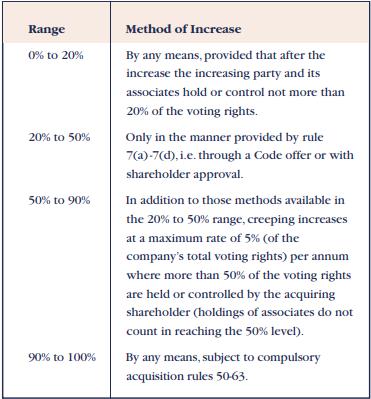
Except as permitted by rule 7, fundamental rule 6(1) generally prohibits a person becoming the holder or controller of an increased percentage of the voting rights in a Code company where that interest would be greater than 20%. Taken together, rules 6 and 7 allow a person to become the holder or controller of an increased percentage only by specific methods. The permissible methods vary according to the person’s position before and after the increase.

Fundamental rule 6(1) was formulated with a view to possible avoidance strategies as found in local and overseas practice. Of particular significance in this regard are the control limb of rule 6(1), the aggregation of associates’ holding under rule 6(1)(a), as well as the definitions of control and associates.
 

The Control Limb

The fundamental rule is concerned with transactions that cause a person to become the holder or controller of an increased percentage of the voting rights in a Code company. If the fundamental rule were triggered solely by changes in a person’s holding, this could be easily avoided by property-based arrangements (e.g. by using nominees) or contractual ones (e.g. by voting agreements). Accordingly, the control limb of rule 6(1) is appropriately viewed as the threshold anti-avoidance measure. It ensures that changes in control of a Code company cannot be hidden behind ownership or contractual arrangements.

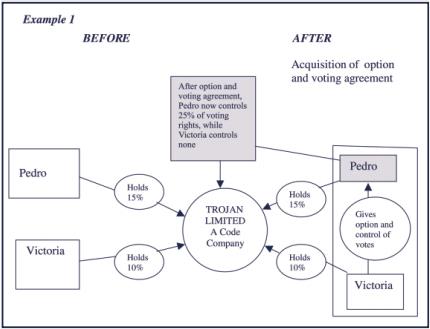
Example 1

Pedro holds 15% of the shares in Code company Trojan Limited. Pedro proposes to acquire an option over Victoria’s 10% holding in Trojan Limited. Victoria agrees to vote her shares in accordance with Pedro’s instruction. [Note: In all diagrams Trojan Limited is a Code company. Shaded boxes or circles signal non-compliance with the Code.
Example 2

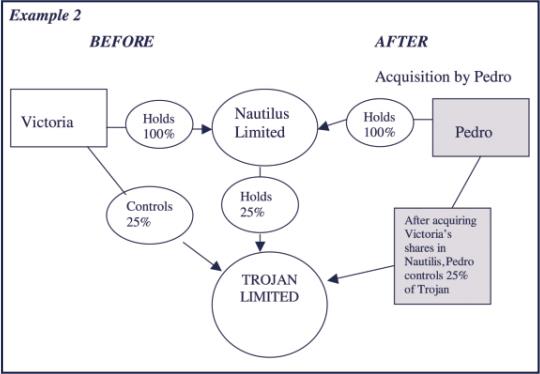
Victoria holds all the shares in Nautilus Limited that, in turn, owns 25% of the shares in Code company Trojan Limited. Pedro proposes to purchase Victoria’s shares in Nautilus Limited.

As the Victoria/Pedro transaction will not alter the holdings in Trojan Limited, it does not cause Pedro to become the holder of an increased percentage of voting rights in the Code company. However, the transaction will provide Pedro with absolute control over Nautilus Limited and thus with control over the 25% parcel in Trojan Limited. By reason of the transaction, Pedro will become the controller of an increased percentage (moving from 0% to 25%) of voting rights in Trojan Limited. As Pedro will control more than 20% of the voting rights after the transaction, Pedro will breach rule 6(1)(a).
 

Broad definition of control

The net cast by the control limb of fundamental rule 6(1) is a wide one, as rule 2(1) defines control, in relation to a voting right, as having directly or indirectly, effective control of the voting right.

When applied to arrangements involving indirect control of a voting right, the fundamental rule will apply to a variety of potential avoidance strategies, subject only to the constraint that the indirect control of voting rights be effective.

Example 3

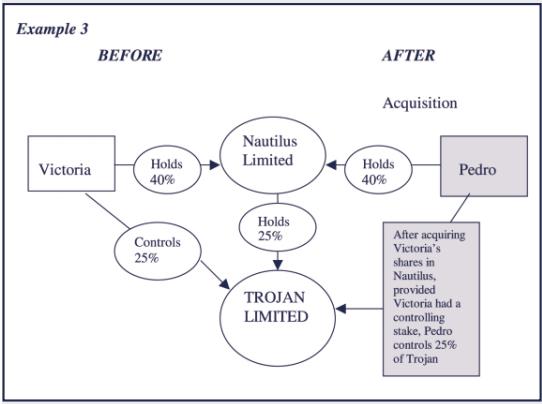
Victoria holds 40% of the shares in listed company Nautilus Limited that in turn owns 25% of the shares in Code company Trojan Limited. Pedro proposes to purchase Victoria’s holding in Nautilus Limited.

As Nautilus Limited is a listed company, it qualifies as a Code company under rule 3(1). Accordingly, the proposed transaction implicates fundamental rule 6(1) in relation to the shares in both Nautilus Limited and Trojan Limited. Of interest in the present context is its application to control of the shares in downstream Trojan Limited.

Assume, for the purposes of the example, that Nautilus Limited’s shareholders will approve Pedro’s purchase of Victoria’s holding in Nautilus Limited pursuant to rule 7(c). Now consider the proposed transaction as it bears upon the holding and controlling of shares in Trojan Limited. The transaction will not increase the percentage of voting rights that Pedro holds in Trojan Limited. Both before and after the transaction, Pedro will hold no voting rights in that Code company.

However, assuming that Victoria’s 40% holding in listed company Nautilus Limited gives Victoria effective control of that company, then, in turn, Victoria will have effective control over Nautilus’s 25% holding in Code company Trojan Limited. The proposed transaction will enable Pedro to accede to that control position. Accordingly, as the proposed transaction will increase from 0% to 25%, the percentage of voting rights in Trojan Limited that is controlled by Pedro, Pedro will contravene rule 6(1)(a) in relation to Trojan Limited.

Note that it is not sufficient for compliance with the Code that the shareholders of Nautilus Limited approved Pedro’s acquisition of Victoria’s shares in Nautilus Limited. The acquisition of control of voting rights in Trojan Limited is one for the shareholders of Trojan Limited to approve.
Associates

The Code is concerned with regulating changes of control of Code companies. The Code would be ineffectual if it concentrated only on voting rights held or controlled by a particular company or individual. It was essential to include in the Code the concept of “association” so that when two or more associated parties acquire ownership of, or control of, voting rights above 20% in a Code company the fundamental rule is triggered.

The concept of associates appears in fundamental rule 6(1)(a) as well as in two of the deeming provisions in rule 6(2). In all three instances, the concept serves as an anti-avoidance measure.

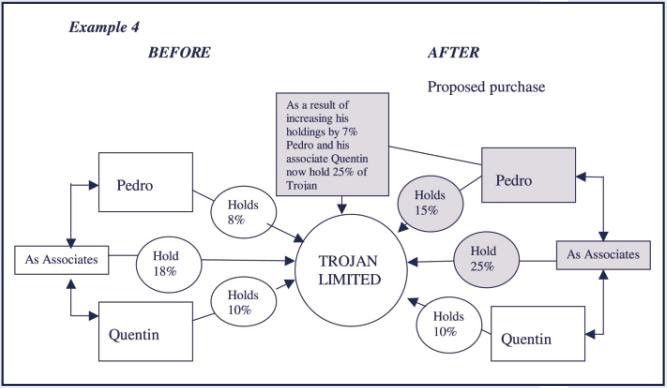
Example 4

Associates Pedro and Quentin hold respectively 8% and 10% of the shares in Code company Trojan Limited. Pedro proposes to increase his holding by 7% to 15% through on market purchases. Pedro’s purchase will not make him the holder or controller of more than 20% in Trojan Limited. The transaction will, nevertheless, contravene rule 6(1)(a). For the purposes of the 20% threshold, Pedro’s post-transaction holding must be aggregated with the holding of associate Quentin. As the proposed transaction increases the combined holding of Pedro and Quentin from 18% to 25%, it will exceed the 20% threshold in rule 6(1)(a). Associate arrangements will also aggregate holdings in upstream companies.
 

Example 5

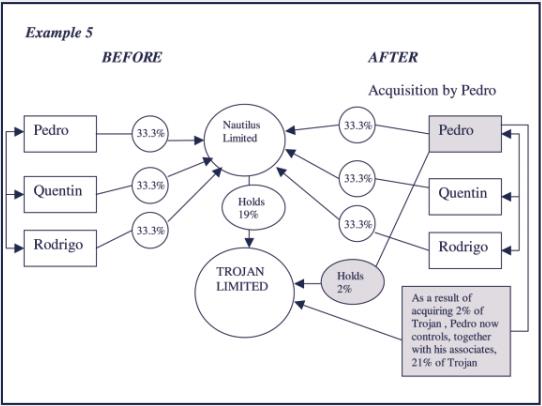
Associates Pedro, Quentin and Rodrigo each hold one third of the shares in Nautilus Limited that in turn owns 19% of the shares in Code company Trojan Limited. Pedro proposes to acquire on his own account a 2% holding in Trojan Limited through on-market purchases.

Viewed in isolation, the proposed acquisition will not cross any of the thresholds set by the fundamental rule. However, the combined holdings of Pedro, Quentin and Rodrigo give them effective control over the affairs of Nautilus Limited and thus control over the 19% holding in Trojan Limited. This control position must be aggregated with the proposed on-market 2% purchase by Pedro. As the aggregated post-transaction control position of Pedro, Quentin and Rodrigo involves more than 20% of the shares in Trojan Limited, the proposed acquisition will cause Pedro to breach rule 6(1)(a).
Broad Definition of Associate

“Associate” is defined in the Code as follows:

Meaning of associate

(1) For the purposes of this Code, a person is an associate of another person if

(a) the persons are acting jointly or in concert; or

(b) the first person acts, or is accustomed to act, in accordance with the wishes of the other person; or

(c) the persons are related companies; or

(d) the persons have a business relationship, personal relationship, or an ownership relationship such that they should, under the circumstances, be regarded as associates; or

(e) the first person is an associate of a third person who is an associate of the other person (in both cases under any of paragraphs (a) to (d)) and the nature of the relationships between the first person, the third person, and the other person (or any of them) is such that, under the circumstances, the first person should be regarded as an associate of the other person.

(2) A director of a company or other body corporate is not an associate of that company or body corporate merely because he or she is a director of that company or body corporate.

The definition of associate has two features that significantly extend the anti-avoidance scope of the fundamental rule.

First, associate status does not presuppose control of the associate’s voting rights. For instance, under rule 4(1)(a), two persons qualify as associates if they act jointly or in concert, even though neither has positive control over the actions of the other. Under rule 4(1)(b), two persons qualify as associates if the one person is accustomed to act (as opposed to required to act) in accordance with the wishes of the other

Secondly, the definition of associate is, in all five limbs, an open-ended one that turns on the facts of the particular situation. This is expressly obvious in relation to rule 4(1)(d) and rule 4(1)(e) which define associate by reference to the term itself under the circumstances. However, fact-based analysis is also anticipated by the element acting jointly or in concert in rule 4(1)(a) and by the element accustomed to act in rule 4(1)(b).

Fact-based analysis even enters into the operation of rule 4(1)(c) under which two related companies qualify as associates. Rule 3 provides that related company has the same meaning as in section 2(3) of the Companies Act l993. Under that section, two companies qualify as related if one company is the subsidiary of the other under section 5. A subsidiary relationship exists under section 5(1), if the one company controls the composition of the board of the other, which will usually depend on the circumstances of the case.

Cumulative scope of the limbs in rule 4(1)

The five limbs of the associate definition apply singularly and cumulatively.

Example 6

Handy Limited holds 25% of the shares in Superior Limited, the remainder of the shares being widely held. Superior Limited is the exclusive distributor of one of the products manufactured by Handy Limited. Handy Limited and Superior Limited each hold 9% of the shares in Code company Trojan Limited and each has a right of first refusal over the other’s holding. Superior Limited acquires on-market another 2% in Trojan Limited. Shortly thereafter, Handy Limited acquires another 1% in Trojan Limited on-market.
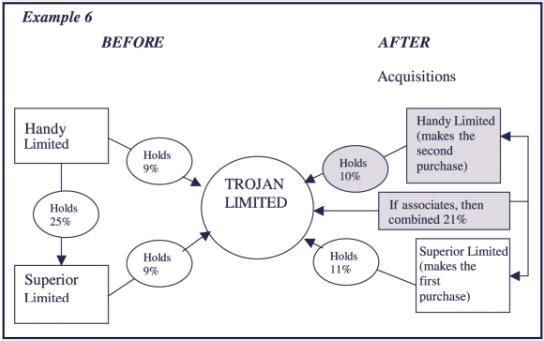
If Handy Limited and Superior Limited qualify as associates, then the 1% acquisition by Handy Limited would breach rule 6(1)(a). The two companies possibly qualify as associates under any of the first four limbs in rule 4(1). The facts relevant to any one particular limb might leave some doubt whether the two companies qualify as associates under that particular limb. However, the Panel can also take into account the cumulative significance of possible qualification under the other limbs.

Combined effect of the control and associate elements

The combined effect of the control and associate elements, in view of their open-ended definitions, significantly expands the potential scope of the fundamental rule.

Example 7

Xavier Limited holds 40% of the shares in closely held investment company Nautilus Limited that in turn holds 19% of the shares in Code company Trojan Limited. Xavier Limited is also the principal lender to highly leveraged Prospect Limited (a closely-held venture capital firm). Prospect Limited proposes to purchase on-market a 5% stake in Trojan Limited.
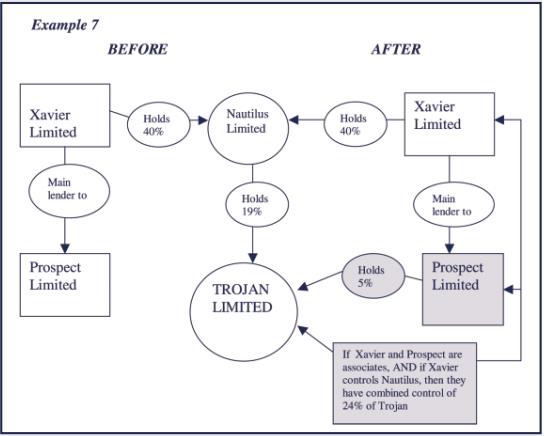
Prospect Limited’s acquisition will trigger rule 6(1)(a) if: a) Xavier Limited and Prospect Limited qualify as associates, i.e. by reason of their debtor/creditor relationship; and b) Xavier Limited has effective control over Nautilus Limited’s shares in Trojan Limited.


Part 2: The Deeming Provisions in Rule 6(2)

Published 1 September 2002

Another important anti-avoidance measure is found in the three deeming provisions in rule 6(2). These provisions address constraints that may otherwise limit the operation of fundamental rule 6(1), particularly in relation to transactions that occur upstream from the Code company. The Code was drafted on the premise that parties should not be able to use upstream transactions to accomplish objectives that could not be attained by transactions in shares of the Code company itself.

Rule 6(2)(a)—Concert acquisitions

Concert acquisitions can be implemented at either the Code company level or upstream.

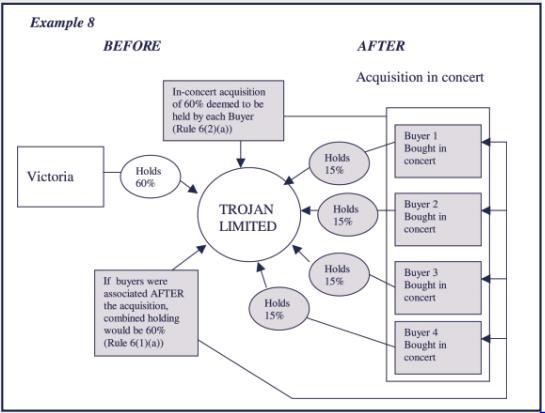
Example 8

Victoria owns 60% of the shares in Code company Trojan Limited. Acting in concert only for purposes of the acquisition, four persons each purchase one fourth of Victoria’s holding in Trojan Limited.

While the transaction enables Victoria to transfer control without needing the agreement of the other shareholders, it does not, without more, fall within fundamental rule 6(1) because rule 6(1) as expressed is concerned with the control position after the acquisition.

Taken individually, none of the purchasers acquires more than 20%. If the purchasers qualified as associates after the event their holdings would be aggregated, thus causing each of them to breach rule 6(1)(a). However, as the concert action was limited only to the acquisition, it is not clear that the purchasers are associates after the event.

Rule 6(2)(a) ensures that the concert acquisition is caught by the fundamental rule. Under rule 6(2)(a), each of the four purchasers is deemed to become the holder and controller of the 60% stake in Trojan Limited. As a result, each of them contravenes rule 6(1)(a).

Concert acquisitions upstream

Rule 6(2)(a) also applies to concert acquisitions that occur upstream of the Code company.

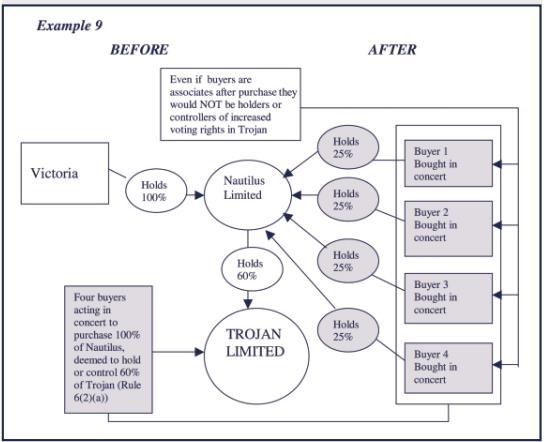
Example 9

Victoria holds all the shares in Nautilus Limited that in turn owns 60% of the shares in Code company Trojan Limited. Purporting to act in concert only for purposes of the acquisition, four persons each purchase one fourth of Victoria’s holding in Nautilus Limited.

In this situation, the attempt to limit the scope of the concert action is unlikely to be effective as four equal shareholders in a closely-held company are very likely to be, depending on the facts, associates. However, even if the purchasers do qualify as associates, there are other difficulties in applying rule 6(1)(a) directly.

In this upstream example, where each purchaser acquires a minority shareholding in Nautilus Limited, none of them becomes the holder or controller of an increased percentage of voting rights in Trojan Limited, which is the threshold requirement of rule 6(1)(a). Here again, rule 6(2)(a) would apply to bring the upstream transaction under fundamental rule 6(1). The four purchasers are acting in concert together and end up controlling the 60% holding in Trojan Limited. Under rule 6(2)(a), each of them will be deemed to be the holder or controller of that 60% holding. This puts all four purchasers in breach of rule 6(1)(a).

Rule 6(2)(b)—Joint ventures

The fundamental rule also anticipates the use of joint ventures to hold and control shares at both the Code company level and upstream of the Code company.

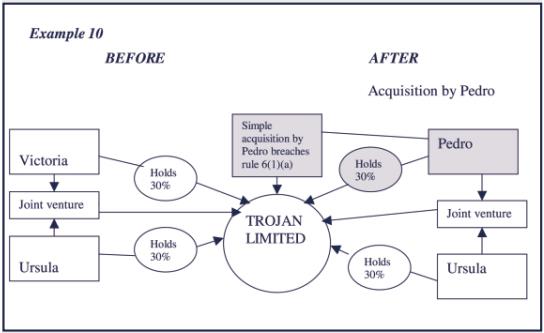
Example 10 (Code company level example)

Victoria and Ursula each own 30% of the shares in Trojan Limited. They manage their combined holding as a joint venture. Pedro proposes to purchase Victoria’s holding and take over Victoria’s position in the joint venture.

The transaction clearly triggers rule 6(1)(a) as it increases Pedro’s holding in Trojan Limited from 0% to 30%. The upstream equivalent is more problematic.

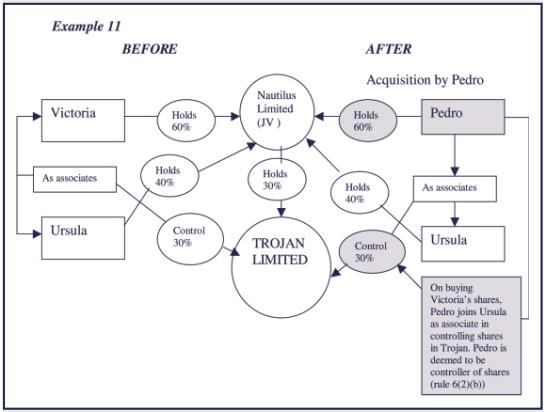
Example 11 (upstream example)

Victoria and Ursula hold respectively 60% and 40% of the shares in joint venture Nautilus Limited that in turn owns 30% of the shares in Code company Trojan Limited. Pedro proposes to purchase Victoria’s holding in Nautilus Limited.

The transaction arguably will not breach rule 6(1). The transaction does not make Pedro the holder of any voting rights in Trojan Limited. The acquisition will provide Pedro with control over the 30% parcel in Trojan Limited via Pedro’s control over the affairs of Nautilus Limited. Pedro may argue that, even though he is a controlling shareholder in Nautilus Limited, the joint venture agreement prevents him from exercising effective control over Nautilus Limited and hence over the 30% parcel in Trojan Limited.

Rule 6(2)(b) addresses this argument. Prior to the transaction, Victoria and Ursula together (as members of Nautilus Limited) controlled 30% of the voting rights in Trojan Limited. The proposed transaction results in another person (Pedro) joining one of them (Ursula) in the controlling of those voting rights. Further, Pedro and Ursula will be controlling the shares as associates. (Even in the absence of an express joint venture agreement, a 60% member and 40% member in a two-person company will normally stand in a business relationship that will make them associates under rule 4(1)(d).)

Under rule 6(2)(b), this associate relationship suffices to deem Pedro to have become the controller of the 30% holding in Trojan Limited. As a result of the transaction, Pedro moves from control over 0% to deemed control over 30% of the voting rights in Code company Trojan Limited and thus breaches rule 6(1)(a).

Extent of scope of rule 6(2)(b)

In example 11, the same result may follow if Pedro acquires only a 10% holding in Nautilus Limited, i.e. by purchase from Victoria or by an issue of new shares by Nautilus Limited. In this situation, Pedro will be joining Victoria and Ursula in the controlling of Nautilus Limited’s 30% holding in Code company Trojan Limited. However, this alone is not sufficient to trigger the deeming rule in rule 6(2)(b). Also required is that Pedro joins Victoria and Ursula as associates in the controlling of the Trojan Limited shares.

It could be expected that Pedro would qualify as an associate of Victoria and Ursula if he joins their joint venture. However, even in the absence of an express joint venture agreement, it is likely that the three members of a closely-held company would stand in a business relationship that, in the absence of special circumstances, would qualify them as associates under rule 4(1)(d).

Rule 6(2)(c) - Inter-Associate Transfers

As discussed in connection with example 4, when a person has associates, under rule 6(1)(a) the associates’ holdings will constrain the person’s acquisitions from third parties. As applied to transfers between associates, fundamental rule 6(1) operates in a straight-forward manner so long as the transaction involves shares in the Code company itself.

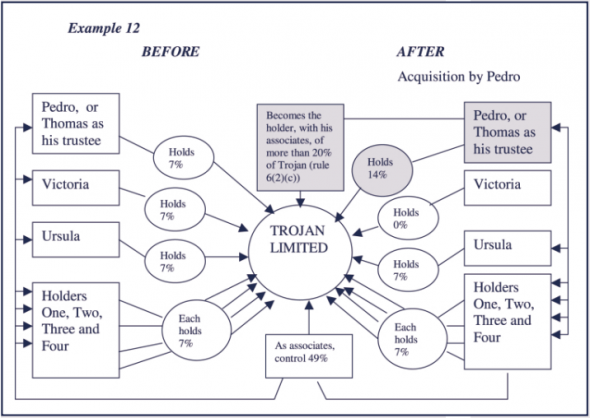
Example 12

Seven associates each own 7% of the shares in Code company Trojan Limited. One associate (Pedro) proposes to acquire the holding of another associate (Victoria).

By reason of the transaction, Pedro will increase his holding of voting rights of Trojan Limited from 7% to 14%. As, after the event, Pedro and the other five associates hold in total more than 20%, the transaction will breach rule 6(1)(a). (Note that, due to the associate relationship (e.g. joint voting agreement), the purchase may not result in Pedro obtaining effective control over an increased percentage of voting rights.)

The rule cannot be circumvented by Pedro’s use of a nominee or other trustee (Thomas) to hold his, and to acquire Victoria’s, shares. In that situation, the transaction will increase Thomas’s holding from 7% to 14%. After the transaction, Thomas will qualify as an associate of the other five members under rule 4(1)(e), i.e. by reason of the associate relationship between Thomas and Pedro and the latter’s associate relationship with the other five members. As after the transaction, Thomas and the other five members hold as associates more than 20% in Trojan Limited, the transaction will cause Thomas to breach rule 6(1)(a).

Inter-associate transactions upstream

Inter-associate transactions are more complex when they occur upstream from the Code company.

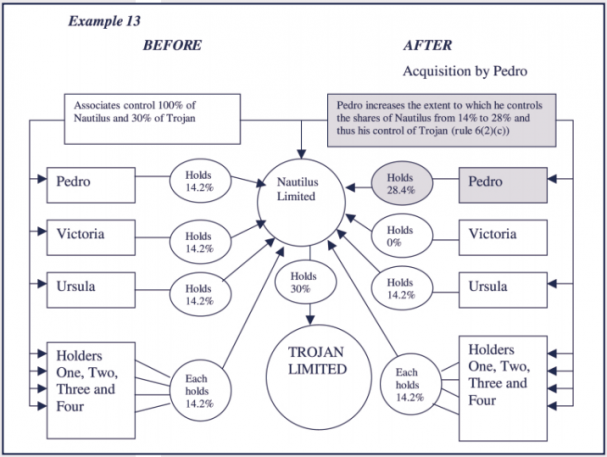
Example 13

The 700 shares in Nautilus Limited are held in equal parcels by seven associates. Nautilus Limited owns 30% of the shares in Code company Trojan Limited. Associate Pedro proposes to acquire associate Victoria’s holding in Nautilus Limited.

After the transaction, Pedro and the five remaining associates will control (via Nautilus Limited) more than 20% in Trojan Limited. However, this does not suffice to breach rule 6(1)(a). The issue is whether the transaction will satisfy the trigger requirement in rule 6(1), i.e. result in Pedro becoming the holder or controller of an increased percentage of voting rights in Trojan Limited. Whilst the transaction will increase Pedro’s holding in Nautilus Limited from 100 shares (around 14%) to 200 shares (around 28%), it is unlikely that, for purposes of rule 6(1)(a), this would result in Pedro becoming the controller of an increased percentage of voting rights in Trojan Limited. Both before and after the transaction, Pedro remains a minority shareholder and, as such, is unable to control the affairs of Nautilus Limited.

The deeming rule in rule 6(2)(c) aims to achieve the same result in this upstream situation as occurs in the very comparable inter-associate transaction at the Code company level explained in example 12.

Prior to the transaction, 30% of the voting rights in Trojan Limited are controlled by a person (Pedro) together with his six associates, via their ownership of Nautilus Limited. By reason of the proposed transaction, Pedro will increase (from 14% to 28%) the extent to which he shares in the controlling of those shares. Under rule 6(2)(c), this is deemed to result in an increase in the percentage of voting rights in Trojan Limited held or controlled by Pedro. This deemed increase satisfies the trigger requirement in rule 6(1)(a) and places Pedro in breach of the fundamental rule.

Acquisitions at both the Code company level and upstream

Acquisition strategies can involve transactions at both the Code company level and upstream.

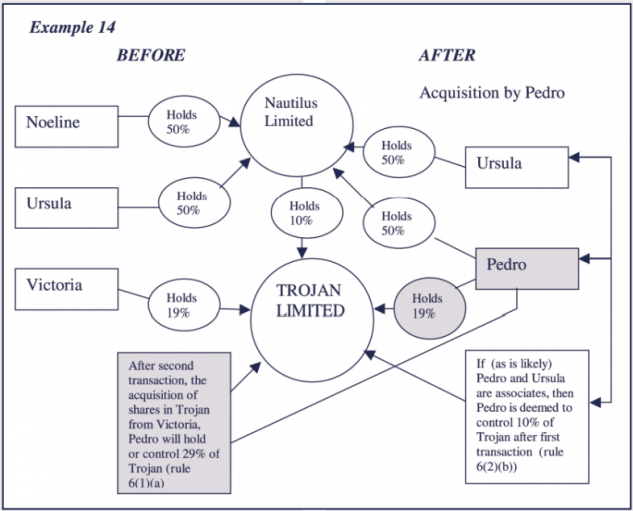
Example 14

Noeline and Ursula each hold one half the shares in Nautilus Limited that in turn owns 10% of the shares in Code company Trojan Limited. Pedro first purchases Noeline’s stake in Nautilus Limited and then Pedro purchases from third party Victoria a 19% holding in Trojan Limited.

Following example 11, Pedro will be deemed, under rule 6(2)(b), to be the controller of the 10% holding in Trojan Limited if, as is likely, Pedro and Ursula are associates after the transaction.

In the subsequent acquisition from Victoria, Pedro will increase his control in Trojan Limited from 10% to 29% and thus breach rule 6(1)(a). It is arguable that the same result follows without regard to rule 6(2)(b). The two shareholders in a 50/50 company such as Nautilus Limited, would almost certainly qualify as associates of Nautilus Limited under rule 4(1)(d) by reason of a business relationship. In the subsequent Pedro/Victoria transaction, Pedro increases his holding in Trojan Limited from 0% to 19%. Because, after this transaction, associate Nautilus Limited’s 10% holding is aggregated with Pedro’s 19% holding, the transaction places Pedro in breach of rule 6(1)(a). The same result would follow if the order of the acquisitions were reversed.

Featured Newsletter

codeword image

April 2026 - Issue 59

In this issue:

  • - Updates to Guidance Notes
  • Back to top